Training Programs

Training Programs
Like in machine learning, a LM application needs to be trained. In that case, we don't update the weights of the model, but optimize the prompts by automatically picking the best examples or generate instructions in order to help the program to perform better on your dataset.
In production settings, this means that you can use smaller and more cost-effective models from your preferred provider while enhancing their accuracy with Synalinks.
Training Flow
graph TB
    subgraph Data
        A[x_train, y_train]
        B[x_test, y_test]
    end
    subgraph Training
        C[program.compile] --> D[program.fit]
        D --> E{val_reward improved?}
        E -->|Yes| F[Save Checkpoint]
        E -->|No| D
    end
    subgraph Evaluation
        G[program.evaluate]
    end
    A --> D
    B --> G
    F --> G
Loading a Dataset
Synalinks provides built-in datasets for training and evaluation:
Training with fit()
Training a program is similar to Keras. Use the fit() method with your data:
history = await program.fit(
    x=x_train,
    y=y_train,
    validation_split=0.2,
    epochs=20,
    batch_size=32,
    callbacks=[program_checkpoint_callback],
)
Saving and Loading Checkpoints
Use callbacks to save the best performing program during training:
program_checkpoint_callback = synalinks.callbacks.ProgramCheckpoint(
    filepath="checkpoint.program.json",
    monitor="val_reward",
    mode="max",
    save_best_only=True,
)

# Load the best checkpoint after training
program.load("checkpoint.program.json")
Key Takeaways
- Dataset Loading: Use built-in datasets or create your own for training.
- Training Loop: The
fit()method handles the training process with configurable epochs, batch size, and validation split. - Checkpointing: Save the best performing model during training using
ProgramCheckpointcallback. - Evaluation: Use
evaluate()to measure performance before and after training.
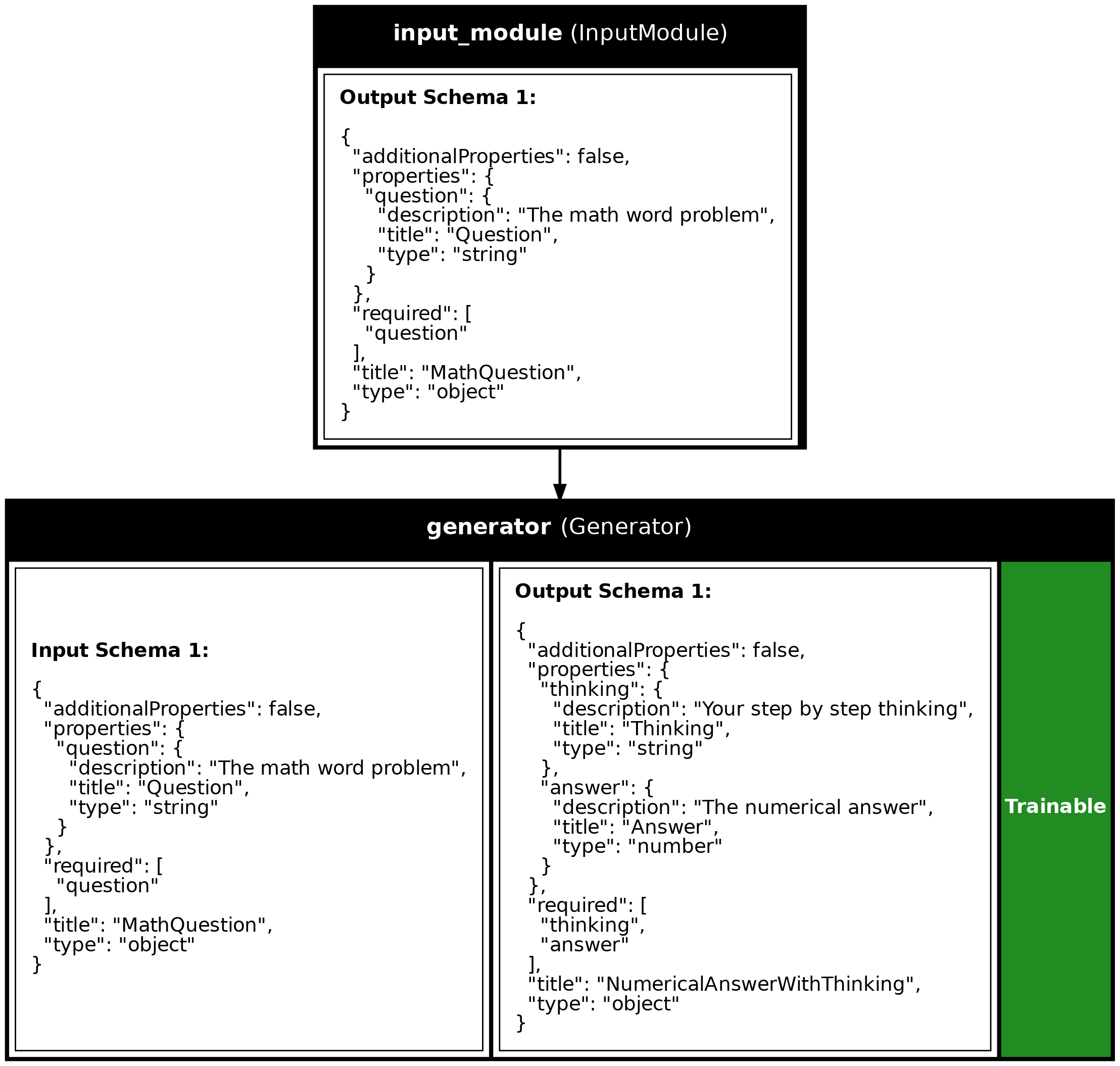
Program Visualization
API References
Source
import asyncio
import os

from dotenv import load_dotenv

import synalinks

NB_EPOCHS = 20
BATCH_SIZE = 32
NB_SAMPLES = None  # Set to a number to limit the dataset size
NB_RUNS = 3

FOLDER = "examples"

checkpoint_filepath = "checkpoint.program.json"


async def main():
    load_dotenv()

    # Enable observability for tracing
    synalinks.enable_observability(
        tracking_uri="http://localhost:5000",
        experiment_name="gsm8k_training",
    )

    # Initialize the language model
    language_model = synalinks.LanguageModel(
        model="gemini/gemini-3.1-flash-lite-preview",
    )

    # ==========================================================================
    # Load the GSM8k dataset
    # ==========================================================================
    print("Loading GSM8k dataset...")
    (x_train, y_train), (x_test, y_test) = synalinks.datasets.gsm8k.load_data()

    if NB_SAMPLES:
        x_train = x_train[:NB_SAMPLES]
        y_train = y_train[:NB_SAMPLES]
        x_test = x_test[:NB_SAMPLES]
        y_test = y_test[:NB_SAMPLES]

    print("Done.")

    # ==========================================================================
    # Create the program
    # ==========================================================================
    print("Creating program...")
    inputs = synalinks.Input(
        data_model=synalinks.datasets.gsm8k.get_input_data_model(),
    )
    outputs = await synalinks.Generator(
        data_model=synalinks.datasets.gsm8k.get_output_data_model(),
        language_model=language_model,
    )(inputs)
    program = synalinks.Program(
        inputs=inputs,
        outputs=outputs,
        name="gsm8k_baseline",
        description="The GSM8k baseline",
    )

    synalinks.utils.plot_program(
        program,
        to_folder=FOLDER,
        show_module_names=True,
        show_schemas=True,
        show_trainable=True,
    )

    # ==========================================================================
    # Compile the program
    # ==========================================================================
    print("Compiling...")
    program.compile(
        reward=synalinks.rewards.ExactMatch(in_mask=["answer"]),
        optimizer=synalinks.optimizers.RandomFewShot(),
    )
    print("Done.")

    # ==========================================================================
    # Baseline evaluation (before training)
    # ==========================================================================
    print(f"Perform baseline evaluation samples with {NB_RUNS} runs...")
    baseline_metric_list = []
    for i in range(NB_RUNS):
        print(f"Run {i + 1}/{NB_RUNS}")
        metrics = await program.evaluate(
            x=x_test,
            y=y_test,
            batch_size=BATCH_SIZE,
        )
        baseline_metric_list.append(metrics)
    print("Done.")

    synalinks.utils.plot_metrics_with_mean_and_std(
        baseline_metric_list,
        to_folder=FOLDER,
        title="Evaluation without training",
    )

    # ==========================================================================
    # Training
    # ==========================================================================
    program.compile(
        reward=synalinks.rewards.ExactMatch(in_mask=["answer"]),
        optimizer=synalinks.optimizers.RandomFewShot(),
    )

    program_checkpoint_callback = synalinks.callbacks.ProgramCheckpoint(
        filepath=os.path.join(FOLDER, checkpoint_filepath),
        monitor="val_reward",
        mode="max",
        save_best_only=True,
    )

    print(f"Start training for {NB_EPOCHS} epochs...")
    history = await program.fit(
        x=x_train,
        y=y_train,
        validation_split=0.2,
        epochs=NB_EPOCHS,
        batch_size=BATCH_SIZE,
        callbacks=[program_checkpoint_callback],
    )
    print("Done.")

    synalinks.utils.plot_history(
        history,
        to_folder=FOLDER,
        to_file="gsm8k_baseline_training_history.png",
    )

    # ==========================================================================
    # Final evaluation (after training)
    # ==========================================================================
    print("Load best performing checkpoint...")
    program.load(os.path.join(FOLDER, checkpoint_filepath))
    print("Done.")

    print("Perform final evaluation...")
    trained_metric_list = []
    for i in range(NB_RUNS):
        print(f"Run {i + 1}/{NB_RUNS}")
        metrics = await program.evaluate(
            x=x_test,
            y=y_test,
            batch_size=BATCH_SIZE,
        )
        trained_metric_list.append(metrics)
    print("Done.")

    metrics_comparison = {
        "without_training": baseline_metric_list,
        "with_training": trained_metric_list,
    }

    synalinks.utils.plot_metrics_comparison_with_mean_and_std(
        metrics_comparison,
        to_folder=FOLDER,
        to_file="gsm8k_evaluation_comparison.png",
        title="Comparison w/o training (GSM8K with EM reward)",
    )


if __name__ == "__main__":
    asyncio.run(main())