Decisions

Making Decisions
Sometimes your AI needs to make a choice: Is this email spam or not? Is this query simple or complex? Should we route to department A or B?
This lesson introduces the Decision module - a powerful way to classify inputs into predefined categories.
What is a Decision?
A Decision is essentially single-label classification. You provide:
- A question - what you want to decide
- Labels - the possible choices
The LLM will pick exactly ONE label from your choices.
decision = await synalinks.Decision(
    question="Is this email spam?",
    labels=["spam", "not_spam"],
    language_model=language_model,
)(email_input)

print(decision["choice"])  # Either "spam" or "not_spam"
How It Works
graph LR
    Input --> Decision
    Decision --> |thinking| T[Reasoning]
    Decision --> |choice| C{Labels}
    C --> L1[easy]
    C --> L2[difficult]
Behind the scenes, Synalinks:
- Creates an Enum schema from your labels
- Uses constrained generation to force the LLM to pick one label
- Returns a structured output with
thinkingandchoicefields
This guarantees you get exactly one of your labels - no ambiguity!
Use Cases
- Routing: Send queries to different handlers based on type
- Filtering: Spam detection, content moderation
- Triage: Prioritize tasks by urgency
- Classification: Categorize documents, tickets, etc.
Complete Example
import asyncio
from dotenv import load_dotenv
import synalinks

class Query(synalinks.DataModel):
    query: str = synalinks.Field(description="The user query")

async def main():
    load_dotenv()
    language_model = synalinks.LanguageModel(model="ollama/mistral:latest")

    inputs = synalinks.Input(data_model=Query)

    # Decision module classifies input into one of the labels
    outputs = await synalinks.Decision(
        question="Evaluate the difficulty to answer the provided query",
        labels=["easy", "difficult"],
        language_model=language_model,
    )(inputs)

    program = synalinks.Program(
        inputs=inputs,
        outputs=outputs,
        name="decision_making",
    )

    # Test with different queries
    result = await program(Query(query="What is 2 + 2?"))
    print(f"Query: 'What is 2 + 2?'")
    print(f"Choice: {result['choice']}")  # Output: "easy"

    result = await program(Query(query="Explain quantum entanglement"))
    print(f"Query: 'Explain quantum entanglement'")
    print(f"Choice: {result['choice']}")  # Output: "difficult"

asyncio.run(main())
Key Takeaways
- Decision Module: Single-label classification that forces the LLM to pick exactly one label from your predefined choices.
- Constrained Output: Uses enum schemas and constrained generation to guarantee a valid label - no ambiguous responses.
- Routing: Use decisions to route inputs to different processing paths based on their characteristics.
- Thinking Field: Decision outputs include a
thinkingfield showing the LLM's reasoning for its choice.
Program Visualization
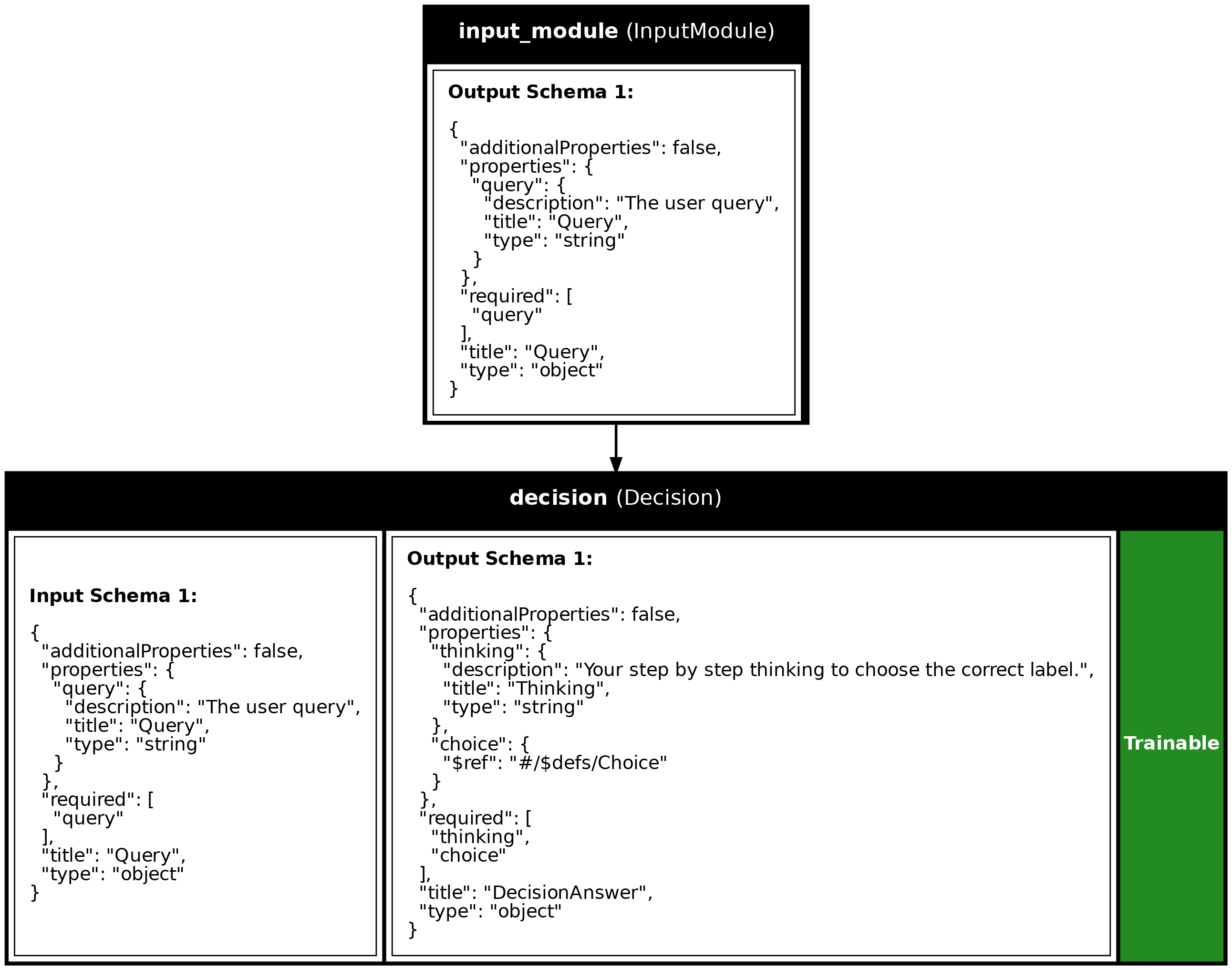
API References
Source
import asyncio
from dotenv import load_dotenv
import synalinks
# =============================================================================
# STEP 1: Define Data Models
# =============================================================================
class Query(synalinks.DataModel):
    """A user query to classify."""

    query: str = synalinks.Field(
        description="The user query",
    )
# =============================================================================
# STEP 2: Build and Run the Program
# =============================================================================
async def main():
load_dotenv()
# Enable observability for tracing (view traces at http://localhost:5000)
# synalinks.enable_observability(
# tracking_uri="http://localhost:5000",
# experiment_name="lesson_3_decisions",
# )
language_model = synalinks.LanguageModel(
model="ollama/mistral:latest",
)
# -------------------------------------------------------------------------
# 2.1: Create a Decision Module
# -------------------------------------------------------------------------
print("=" * 60)
print("Building a Decision-Making Program")
print("=" * 60)
inputs = synalinks.Input(data_model=Query)
# Create a Decision module that classifies query difficulty
# The LLM will output EXACTLY one of the labels
outputs = await synalinks.Decision(
question="Evaluate the difficulty to answer the provided query",
labels=["easy", "difficult"], # Only these two choices!
language_model=language_model,
)(inputs)
program = synalinks.Program(
inputs=inputs,
outputs=outputs,
name="decision_making",
description="Classifies queries by difficulty",
)
# Generate visualization
synalinks.utils.plot_program(
program,
to_folder="examples",
show_module_names=True,
show_schemas=True,
show_trainable=True,
)
# -------------------------------------------------------------------------
# 2.2: Test the Decision Module
# -------------------------------------------------------------------------
print("\nTesting with different queries...")
print("-" * 60)
# Test with an easy query
easy_query = Query(query="What is 2 + 2?")
result = await program(easy_query)
print(f"\nQuery: '{easy_query.query}'")
print(f"Thinking: {result['thinking'][:60]}...")
print(f"Choice: {result['choice']}")
# Test with a difficult query
hard_query = Query(
query="Explain the implications of Gödel's incompleteness theorems"
)
result = await program(hard_query)
print(f"\nQuery: '{hard_query.query}'")
print(f"Thinking: {result['thinking'][:60]}...")
print(f"Choice: {result['choice']}")
if __name__ == "__main__":
asyncio.run(main())
Run log
The log below is the unedited combined output of running the example above with local models (ollama).
Full run log: examples/3_decisions.log
============================================================
Building a Decision-Making Program
============================================================

Testing with different queries...
------------------------------------------------------------

Query: 'What is 2 + 2?'
Thinking: The given query involves basic arithmetic operations, specif...
Choice: easy

Query: 'Explain the implications of Gödel's incompleteness theorems'
Thinking: Gödel's Incompleteness Theorems are a fundamental concept in...
Choice: difficult