Conditional Branches

Conditional Branches
In Lesson 3, you learned to make decisions. Now, let's use those decisions to create conditional branches - programs that take different paths based on the input.
Why Conditional Branches?
Real-world applications often need different processing for different cases:
- Simple questions → Quick answer
- Complex questions → Detailed reasoning
- Urgent tickets → Fast track processing
- Normal tickets → Standard queue
How Conditional Branches Work
The Branch module combines decision-making with conditional execution:
graph LR
    Input --> Decision
    Decision -->|easy| A[Easy Branch]
    Decision -->|difficult| B[Hard Branch]
    A --> Outputs
    B --> Outputs
Only ONE branch executes - the others output None.
(easy_result, hard_result) = await synalinks.Branch(
    question="How complex is this query?",
    labels=["easy", "difficult"],
    branches=[
        synalinks.Generator(data_model=SimpleAnswer, ...),    # For "easy"
        synalinks.Generator(data_model=DetailedAnswer, ...),  # For "difficult"
    ],
    language_model=language_model,
)(inputs)

# If query was "easy": easy_result has data, hard_result is None
# If query was "difficult": easy_result is None, hard_result has data
Handling None Outputs
Since unselected branches return None, you can use logical operators
to merge results (covered in Lesson 5):
Complete Example
import asyncio
from dotenv import load_dotenv
import synalinks

class Query(synalinks.DataModel):
    query: str = synalinks.Field(description="The user query")

class Answer(synalinks.DataModel):
    answer: str = synalinks.Field(description="The correct answer")

class AnswerWithThinking(synalinks.DataModel):
    thinking: str = synalinks.Field(description="Your step by step thinking")
    answer: str = synalinks.Field(description="The correct answer")

async def main():
    load_dotenv()
    language_model = synalinks.LanguageModel(model="ollama/mistral:latest")

    inputs = synalinks.Input(data_model=Query)

    # Branch routes to different generators based on decision
    (easy_branch, hard_branch) = await synalinks.Branch(
        question="Evaluate the difficulty to answer the provided query",
        labels=["easy", "difficult"],
        language_model=language_model,
        branches=[
            synalinks.Generator(data_model=Answer, language_model=language_model),
            synalinks.Generator(data_model=AnswerWithThinking, language_model=language_model),
        ],
    )(inputs)

    program = synalinks.Program(
        inputs=inputs,
        outputs=[easy_branch, hard_branch],
        name="conditional_branches",
    )

    # One output will be None depending on which branch was taken
    results = await program(Query(query="What is 2 + 2?"))
    print(f"Easy branch: {results[0]}")  # Has data
    print(f"Hard branch: {results[1]}")  # None

asyncio.run(main())
Key Takeaways
- Branch Module: Combines Decision with multiple processing paths - routes inputs to different modules based on classification.
- Exclusive Execution: Only one branch executes per input; others
return
None. - Tuple Output: Branch returns a tuple of outputs, one per label, where only the selected branch has data.
- OR Operator: Use
result1 | result2to merge branch outputs and get the non-None result.
Program Visualization
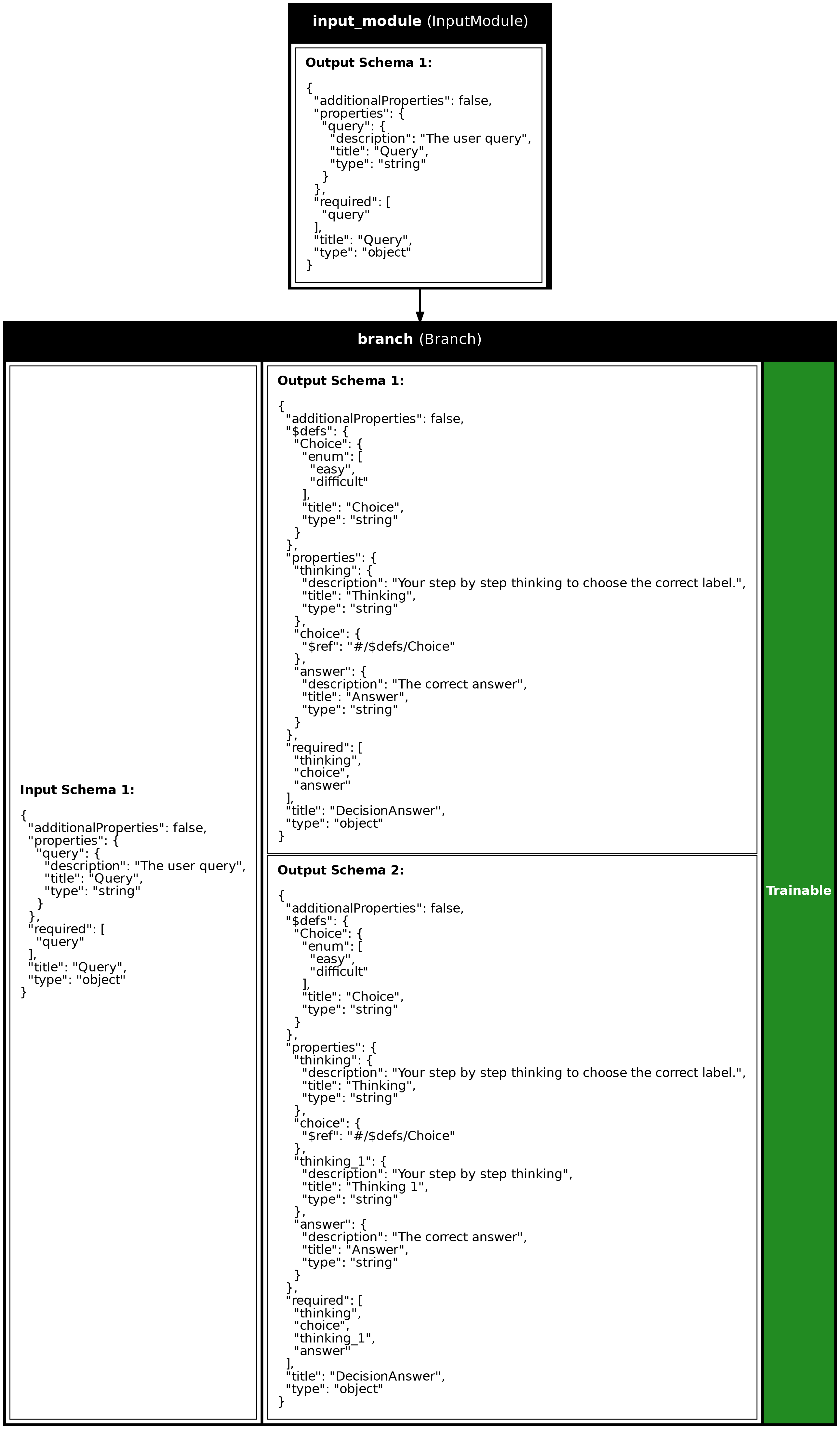
API References
Answer
AnswerWithThinking
Bases: DataModel
A detailed answer with reasoning (for hard questions).
Source code in examples/4_conditional_branches.py
Source
import asyncio
from dotenv import load_dotenv
import synalinks
# =============================================================================
# STEP 1: Define Data Models
# =============================================================================
class Query(synalinks.DataModel):
"""A user query to process."""
query: str = synalinks.Field(
description="The user query",
)
class Answer(synalinks.DataModel):
    """A simple, direct answer (for easy questions)."""

    answer: str = synalinks.Field(
        description="The correct answer",
    )
class AnswerWithThinking(synalinks.DataModel):
    """A detailed answer with reasoning (for hard questions)."""

    thinking: str = synalinks.Field(
        description="Your step by step thinking",
    )
    answer: str = synalinks.Field(
        description="The correct answer",
    )
# =============================================================================
# STEP 2: Build and Run the Program
# =============================================================================
async def main():
load_dotenv()
# Enable observability for tracing (view traces at http://localhost:5000)
# synalinks.enable_observability(
# tracking_uri="http://localhost:5000",
# experiment_name="lesson_4_conditional_branches",
# )
language_model = synalinks.LanguageModel(
model="ollama/mistral:latest",
)
# -------------------------------------------------------------------------
# 2.1: Create Conditional Branches
# -------------------------------------------------------------------------
print("=" * 60)
print("Building a Program with Conditional Branches")
print("=" * 60)
inputs = synalinks.Input(data_model=Query)
# Create a Branch module that routes to different generators
# based on the decision result
(easy_branch, hard_branch) = await synalinks.Branch(
question="Evaluate the difficulty to answer the provided query",
labels=["easy", "difficult"], # Maps to branches by index
language_model=language_model, # Required for the internal decision
branches=[
# Branch 0: For "easy" queries - simple answer
synalinks.Generator(
data_model=Answer,
language_model=language_model,
name="easy_answerer",
),
# Branch 1: For "difficult" queries - detailed reasoning
synalinks.Generator(
data_model=AnswerWithThinking,
language_model=language_model,
name="hard_answerer",
),
],
)(inputs)
# Create program with both outputs
# One will be None depending on which branch was taken
program = synalinks.Program(
inputs=inputs,
outputs=[easy_branch, hard_branch],
name="conditional_branches",
description="Routes queries to different handlers based on difficulty",
)
# Generate visualization
synalinks.utils.plot_program(
program,
to_folder="examples",
show_module_names=True,
show_schemas=True,
show_trainable=True,
)
# -------------------------------------------------------------------------
# 2.2: Test with Different Queries
# -------------------------------------------------------------------------
print("\nTesting conditional branches...")
print("-" * 60)
# Test with an easy query
easy_query = Query(query="What is 2 + 2?")
results = await program(easy_query)
print(f"\nQuery: '{easy_query.query}'")
print(f"Easy branch result: {results[0]}")
print(f"Hard branch result: {results[1]}")
# Test with a difficult query
hard_query = Query(
query="Explain quantum entanglement and its implications for computing"
)
results = await program(hard_query)
print(f"\nQuery: '{hard_query.query}'")
print(f"Easy branch result: {results[0]}")
if results[1]:
print(f"Hard branch result: {results[1]['answer'][:80]}...")
if __name__ == "__main__":
asyncio.run(main())
Run log
The log below is the unedited combined output of running the example above with local models (ollama).
Full run log: examples/4_conditional_branches.log
============================================================
Building a Program with Conditional Branches
============================================================

Testing conditional branches...
------------------------------------------------------------

Query: 'What is 2 + 2?'
Easy branch result: <JsonDataModel schema={'additionalProperties': False, 'properties': {'thinking': {'description': 'Your step by step thinking to choose the correct label.', 'title': 'Thinking', 'type': 'string'}, 'choice': {'enum': ['easy', 'difficult'], 'title': 'Choice', 'type': 'string'}, 'answer': {'description': 'The correct answer', 'title': 'Answer', 'type': 'string'}}, 'required': ['thinking', 'choice', 'answer'], 'title': 'DecisionAnswer', 'type': 'object'}, json={'thinking': 'The given query involves basic arithmetic operations, specifically addition. The operation itself and the numbers involved are simple.', 'choice': 'easy', 'answer': '4'}>
Hard branch result: None

Query: 'Explain quantum entanglement and its implications for computing'
Easy branch result: None
Hard branch result: Quantum entanglement is a phenomenon where two or more particles become linked a...